Built-In Checks and Balances: How Digital CoCs Can Help Reduce Electrical Compliance Errors
Electrical compliance is about far more than completing a form.
Behind every Certificate of Compliance is a professional electrician taking responsibility for an electrical installation, performing the required inspections and tests, recording results and ensuring that the appropriate compliance requirements have been addressed.
That carries significant responsibility.
And when you're moving between jobs, answering calls, managing employees, dealing with customers and trying to keep up with paperwork, it's easy for administrative mistakes to creep in.
A missing test result.
An incomplete field.
A forgotten annexure.
A photograph that was never attached.
Information entered in the wrong place.
These may appear to be small administrative issues, but they can create unnecessary delays and additional work.
This is where digital electrical compliance software can make a meaningful difference.
Energy Warehouse (EW) doesn't simply replace a paper Certificate of Compliance with an electronic version.
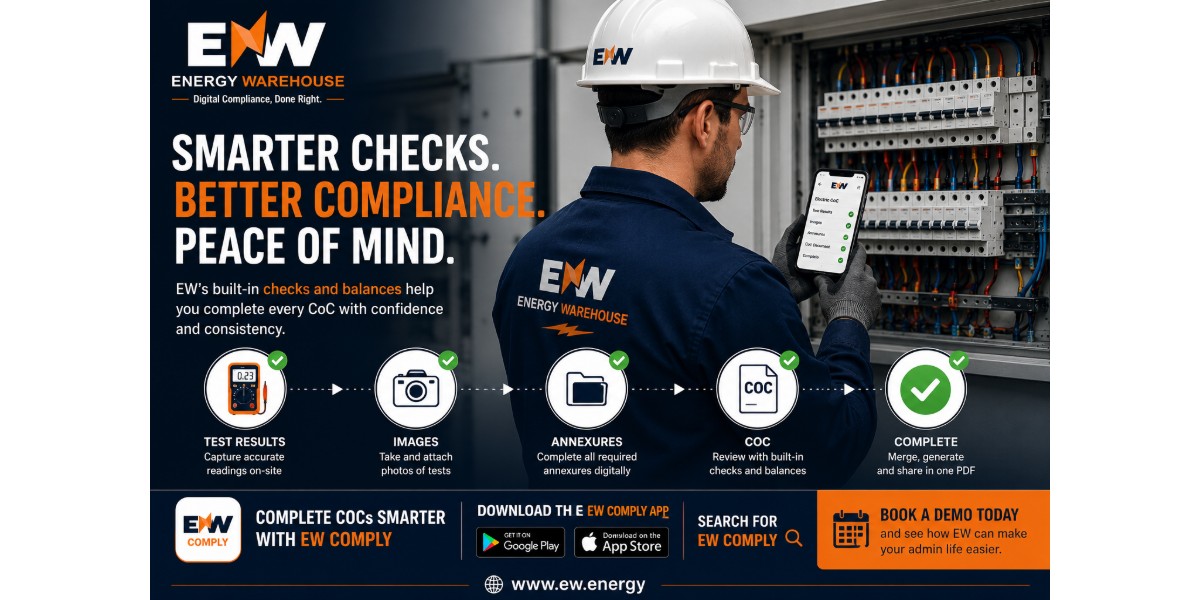
The platform incorporates built-in checks and balances and guided test parameters designed to help electricians work through the compliance process in a more structured and consistent way.
The electrician remains the professional responsible for the work.
EW provides the digital tools to support them.
The Problem With Paper-Based Compliance
Paper has one major limitation:
It doesn't help you.
A paper form doesn't know whether you've forgotten something.
It doesn't guide you through your workflow.
It doesn't organise your photographs.
It doesn't automatically save your work to the cloud.
It doesn't remind you of test parameters.
And it certainly doesn't help you find a completed CoC six months later.
The electrician carries the entire administrative burden.
That's simply how compliance documentation has traditionally worked.
Digital technology provides an opportunity to change that.
Digital CoCs Should Do More Than Replace Paper
There's an important distinction between a digital form and a digital compliance platform.
A digital form is essentially paper displayed on a screen.
You type instead of writing.
That's useful, but it doesn't fundamentally change the process.
A proper digital compliance platform should help structure the workflow around the person completing the documentation.
That's where Energy Warehouse's approach becomes important.
EW provides a digital environment where the electrician can manage the CoC, test information, annexures, supporting documents, photographs and other job information together.
More importantly, the platform's checks and balances can help guide the user through the process.
What Are Checks and Balances?
In simple terms, checks and balances are safeguards built into a digital workflow.
They are designed to help identify situations where information may be incomplete, inconsistent or potentially overlooked.
Think about the difference between filling in a paper form and using online banking.
When transferring money, your banking app doesn't simply present you with blank boxes.
It checks information.
It asks for confirmation.
It structures the process.
It helps reduce obvious mistakes.
Electrical compliance software can apply a similar principle to documentation.
Guided Test Parameters
One of EW's important features is its built-in test parameters.
These help guide the electrician through relevant tests and remind the user of applicable requirements during the process.
This can be particularly useful during a busy working day.
The objective isn't to tell a qualified electrician how to do their job.
It's to provide a structured digital framework around the work they're already doing.
Think of It as a Digital Assistant
An experienced electrician may have completed hundreds or even thousands of tests.
That experience is invaluable.
But experienced professionals are still human.
People get interrupted.
Phones ring.
Customers ask questions.
Employees need assistance.
Suppliers call.
Another job suddenly becomes urgent.
Digital checks provide another layer of support.
Not a replacement for knowledge.
Not a replacement for training.
Not a replacement for professional responsibility.
A support mechanism.
Reducing Administrative Mistakes
Consider a traditional CoC workflow.
An electrician completes an inspection and writes information down.
Later, they return to the office.
They review their notes.
They locate their photographs.
They complete the documentation.
They add annexures.
They scan supporting documents.
They combine files.
They send everything to the customer.
Every additional step creates another opportunity for something to be missed.
Digital workflows can consolidate many of these activities into one process.
Capture Information While You're On-Site
One of the easiest ways to reduce errors is to capture information while it's fresh.
Instead of trying to remember what happened hours later, EW gives contractors the option to complete the CoC on-site.
Test information can be captured while working through the job.
Observations can be recorded.
Photographs can be taken.
Supporting information can be associated with the job.
This reduces reliance on memory.
And that's important.
Test Results Belong With the Job
Paper test readings can create problems.
They can be:
- Misread
- Misplaced
- Entered incorrectly later
- Associated with the wrong job
- Damaged
- Forgotten in a vehicle
When information is captured directly within a digital job, the workflow becomes much more organised.
The test information stays associated with the relevant project.
Photographic Evidence in the Same Workflow
Electricians increasingly use photographs as part of their job records.
The problem is that photographs often end up in the phone's general camera gallery.
After a week of work, there could be hundreds of images.
Which photograph belonged to which property?
Which DB was that?
Was this before or after the repair?
EW allows images to be captured as part of the job workflow.
That provides context.
The image isn't simply sitting on a phone.
It becomes part of the job record.
Videos Can Add Even More Context
Some information is difficult to demonstrate with a photograph.
Video can be useful for recording:
- Equipment operation
- Site conditions
- Fault behaviour
- Installation observations
- Testing processes
By keeping this information connected to the job, contractors can create a more comprehensive digital history.
Annexures Without the Administrative Headache
Annexures can create additional paperwork, particularly where information needs to be repeated.
EW includes pre-designed annexure functionality that can help streamline this process.
Information such as additional circuits can be transferred to relevant annexure pages where applicable, reducing repetitive data entry.
That's another example of digital technology doing more than simply replacing handwriting.
It's reducing unnecessary administration.
Templates Improve Consistency
Most electrical contractors encounter similar types of jobs repeatedly.
Residential.
Commercial.
Maintenance.
Inspections.
Solar.
Electric fence installations.
Why enter the same information again and again?
Frequently used documents can be marked as templates within EW.
Repetitive fields can then be pre-populated.
This provides two advantages.
Speed and consistency.
When information is standardised, there are fewer opportunities for unnecessary variation.
Voice-to-Text Can Reduce Manual Entry
Typing on a mobile phone while working on-site isn't always convenient.
EW's voice-to-text functionality provides another option.
Instead of typing a long observation, the electrician can dictate the information.
This can be particularly useful for:
- Site observations
- Notes
- Fault descriptions
- Installation comments
- Follow-up information
The less friction there is in capturing information, the more likely it is to be recorded while it's still relevant.
Checks and Balances Support Consistency Across Teams
The value of a structured digital workflow becomes even greater when a company employs multiple electricians.
Without a central system, every electrician may develop their own administrative habits.
One person takes extensive photographs.
Another takes very few.
One records information immediately.
Another does it at the office.
One organises documents carefully.
Another relies on WhatsApp.
This makes consistency difficult.
A shared digital platform gives the business a common workflow.
That can help create more consistent documentation across the organisation.
Better Electrical Team Management
EW allows businesses to add team members and assign roles and responsibilities.
This means information doesn't have to remain isolated with one person.
Depending on the team's workflow, different people can contribute to the same job.
For example:
Electrician: performs the testing.
Assistant: captures supporting information.
Administrator: manages customer documentation.
Supervisor: reviews job progress.
Everyone can contribute within a more structured environment.
Digital Records Improve Accountability
A well-organised digital record can also improve accountability.
Instead of trying to reconstruct what happened from pieces of paper, messages and photographs, the relevant information is associated with the job.
That can make internal reviews easier.
It can also help businesses identify where processes need improvement.
Less Rework Means Greater Productivity
Errors don't only create compliance concerns.
They cost time.
Imagine discovering at the office that you forgot something important on-site.
Now someone may need to:
Call the customer.
Find the electrician.
Search for information.
Locate photographs.
Correct documentation.
Or potentially return to the property.
That is rework.
And rework is expensive.
Preventing a mistake can take seconds.
Correcting one can take hours.
Professional Documentation Builds Customer Confidence
Customers may not understand every technical detail of an electrical installation.
But they understand professionalism.
When they receive organised digital documentation instead of a collection of scans, photographs and separate files, it creates a different impression.
A structured compliance process says:
This business takes its work seriously.
That's valuable for electricians trying to differentiate themselves in a competitive market.
Merge Your Documents Into One PDF
Once the documentation is ready, EW allows supporting documents and annexures to be arranged in the preferred order and merged into a single PDF.
This makes final document delivery considerably cleaner.
Instead of:
COC.pdf
Annexure1.pdf
Photo1.jpg
Photo2.jpg
TestResults.pdf
AdditionalDocument.pdf
the customer can receive one organised document package.
One PDF.
Easy to send.
Easy to save.
Easy to retrieve.
Share Through WhatsApp or Email
Once the documentation is ready, it can be shared digitally.
For many contractors, WhatsApp is already one of the primary ways they communicate with customers.
EW fits naturally into that modern workflow.
Complete the documentation.
Merge the files.
Share the final PDF.
Done.
Secure Cloud Storage Changes Record Keeping
Completing a CoC is only the beginning of the document's life.
The business also needs to retain records.
Traditional filing means:
Folders.
Cabinets.
Boxes.
Storage rooms.
And eventually:
"Where did we put that CoC?"
With EW, completed records can be stored digitally in the cloud.
Instead of manually going through filing cabinets, contractors can search their digital records.
Find Old CoCs Faster
Imagine a customer phones and asks:
"Can you send me the CoC you completed for us last year?"
With paper, someone may need to search through files.
With organised digital records, historical documentation becomes considerably easier to manage.
Records can be searched using information such as the customer's details, erf number or date.
That's not simply convenient.
It's an administrative efficiency.
Checks and Balances Are About Supporting the Professional
It's important to be clear about what technology can and cannot do.
Software cannot replace:
- Electrical knowledge
- Professional judgement
- Correct testing
- Appropriate qualifications
- Regulatory responsibility
Those remain with the electrician.
What technology can do is provide structure.
It can help organise information.
It can guide workflows.
It can provide reminders.
It can reduce repetitive administration.
And it can help prevent obvious information from being overlooked.
That's the real value of checks and balances.
The Business Case for Fewer Errors
Imagine a contractor completes 50 CoCs every month.
If only 10% require some form of administrative correction, that's five jobs that need to be revisited.
Suppose each correction takes just 20 minutes.
That's already more than an hour and a half of unnecessary work.
And that's a conservative example.
Some mistakes require much more time.
Reducing errors therefore isn't only about compliance.
It's about profitability.
Saving Time Without Cutting Corners
There's sometimes a misconception that completing documentation faster means compromising quality.
It shouldn't.
The objective is to remove unnecessary administration, not necessary compliance work.
An electrician still needs to inspect.
Still needs to test.
Still needs to apply professional judgement.
Still needs to ensure the installation meets applicable requirements.
What digital technology can reduce is the time spent:
- Rewriting information
- Searching for photographs
- Filing documents
- Scanning paperwork
- Combining PDFs manually
- Looking for historical records
That's where productivity gains come from.
The Future of Compliance Is Assisted, Not Automated Away
Digital transformation is happening across almost every profession.
Accounting software assists accountants.
Design software assists engineers.
Diagnostic equipment assists technicians.
Compliance software assists electricians.
The technology doesn't eliminate the professional.
It gives the professional better tools.
EW's vision is to provide those tools to the electrical industry.
Adding Value to the Electrical Industry
Energy Warehouse's objective goes beyond simply selling digital CoCs.
EW seeks to add value to the electrical industry by helping contractors improve their administrative processes, documentation and productivity.
A stronger compliance ecosystem benefits everyone.
Electricians benefit from better workflows.
Businesses benefit from improved productivity.
Customers benefit from professional documentation.
And the industry benefits from greater consistency.
Frequently Asked Questions
What are checks and balances in electrical compliance software?
Checks and balances are digital safeguards and structured workflow elements designed to help users identify missing or potentially inconsistent information while completing documentation.
Does EW tell an electrician whether an installation is compliant?
The electrician remains responsible for inspection, testing, professional judgement and compliance. EW provides digital tools and test parameters to support the documentation process.
Can EW help reduce mistakes on CoCs?
EW's built-in checks, guided test parameters and structured digital workflow are designed to help minimise avoidable user mistakes and improve consistency.
Can I capture test photographs through the app?
Yes. Relevant photographs can be captured on-site and associated with the job.
Can EW handle annexures?
Yes. EW supports annexure functionality and can help reduce repetitive data entry.
Can multiple employees work on jobs?
Yes. Team members can be added so businesses can collaborate and assign appropriate roles and responsibilities.
Can documents be merged?
Yes. Supporting documentation can be arranged and merged into a single PDF for convenient sharing.
Where are completed CoCs stored?
Completed jobs and associated records can be stored securely in the cloud, making historical documentation easier to retrieve.
Conclusion
Electrical compliance carries responsibility.
The electrician's expertise will always remain at the centre of the process.
But the administrative tools surrounding that expertise can improve dramatically.
Paper provides a blank form.
Digital compliance software can provide a structured workflow.
With built-in checks and balances, guided test parameters, photographs, videos, annexures, templates, team collaboration and cloud storage, Energy Warehouse helps electricians create a more organised approach to compliance administration.
Fewer avoidable mistakes.
Less duplicated work.
Better records.
More consistent documentation.
And more time to concentrate on the electrical work itself.
That is what digital transformation should deliver.
Put Another Set of Checks Behind Every CoC
Discover how Energy Warehouse can help you complete your electrical compliance documentation more efficiently while providing built-in checks and balances throughout the process.
Download EW Comply from the Google Play Store or Apple App Store.
Search: EW Comply
Visit www.ew.energy
Book a demo today and see how EW can make your admin life easier.
Energy Warehouse — Digital Compliance, Done Right.