
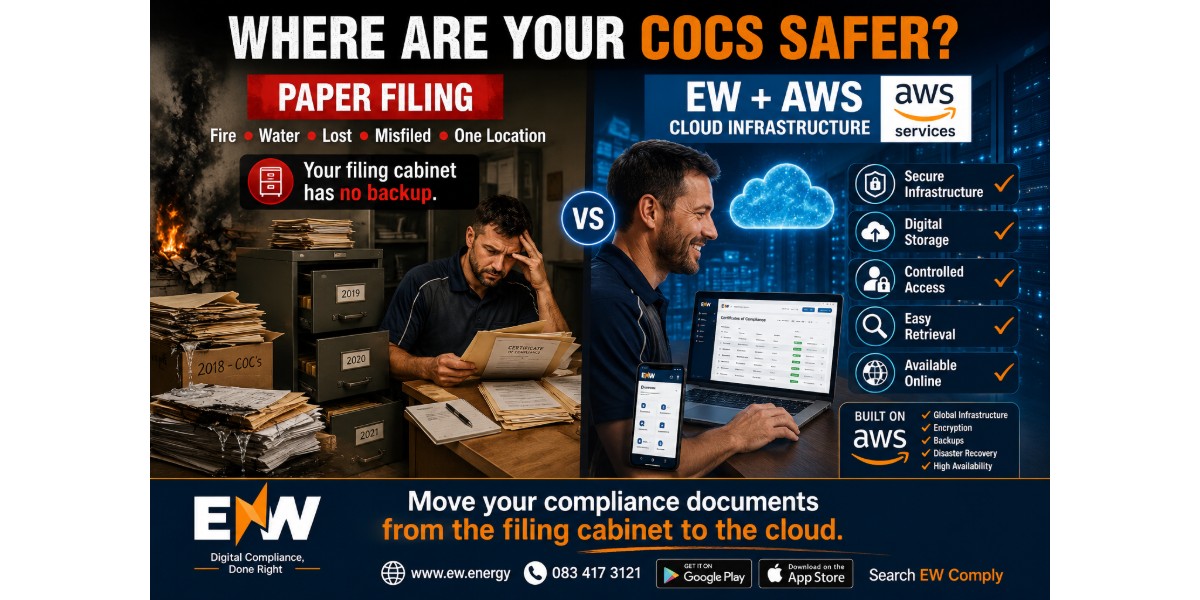
Cloud vs Paper: How EW Helps Keep Your Compliance Documents Safe
For decades, electrical contractors have relied on filing cabinets, folders and boxes to store Certificates of Compliance and other important documentation.
Complete the document. Print it. File it. Store it.
But there is one important question:
Is a piece of paper sitting in a filing cabinet really the safest way to protect an important compliance document?
At Energy Warehouse (EW), we believe there is a better way.
EW is a digital compliance platform designed to help electrical professionals create, manage and store their compliance documentation digitally.
And when it comes to cloud infrastructure, EW makes use of Amazon Web Services (AWS).
AWS is one of the world's major cloud infrastructure providers and provides the underlying infrastructure and security capabilities used by organisations around the world.
So instead of thinking only about going paperless, we should be thinking about something much more important:
How do we protect the information?
The Problem With Traditional Paper Filing
Paper feels secure because you can physically see it.
You complete a Certificate of Compliance, place it in a folder and put the folder in a filing cabinet.
But consider what could happen to that document.
It could be:
- Misfiled
- Accidentally discarded
- Damaged by water
- Destroyed by fire
- Stolen
- Removed from the file
- Damaged over time
- Filed under the wrong customer or project
- Difficult to find several years later
And perhaps the biggest problem is this:
Your filing cabinet cannot automatically create a backup of itself.
If the only copy of an important document is destroyed, recovering it may be extremely difficult — or impossible.
What Changes When You Use EW?
EW changes the way compliance documentation is created and managed.
Instead of completing a document and relying on a physical filing system, your digital compliance records can form part of a centralised digital environment.
This means you are no longer dependent on:
One document.
One folder.
One filing cabinet.
One office.
Your documentation becomes part of your digital business records.
That makes it easier to organise, retrieve and manage your documentation when you need it.
EW Uses AWS Cloud Infrastructure
The security of the underlying infrastructure is important, which is why the use of AWS is significant.
AWS describes cloud security as a shared responsibility.
AWS is responsible for protecting the infrastructure that operates AWS Cloud services — including the underlying hardware, software, networking and facilities.
The customer using AWS remains responsible for aspects of security within its cloud environment, depending on the AWS services being used. This includes areas such as application configuration, permissions and management of data.
This is an important distinction.
We would never claim that simply using AWS makes an application impossible to compromise.
No responsible technology company should claim that any digital system is 100% immune to security threats.
Instead, AWS provides sophisticated infrastructure and security capabilities upon which secure applications can be built.
How Secure Is AWS?
AWS states that its data-centre and network architecture is built to meet the requirements of security-sensitive organisations. Its data centres incorporate multiple layers of physical and operational security and are subject to third-party audits.
AWS also maintains internationally recognised security certifications.
For example, AWS is certified for ISO/IEC 27001:2022, as well as ISO 27017 and ISO 27018 within the applicable scope. These certifications are independently audited.
AWS infrastructure also supports a wide range of security and compliance programmes, including SOC reporting and PCI DSS, depending on the services and regions involved.
For EW customers, the important point is simple:
EW isn't relying on a filing cabinet or an office computer as the foundation for document storage. We use professional cloud infrastructure from AWS.
What About Encryption?
Encryption is one of the major advantages available to digital systems.
AWS services support encryption technologies for protecting data at rest and in transit, depending on the service and how it is configured. AWS uses established cryptographic standards and provides services and controls that customers can use when building secure applications.
Compare that concept with a paper document.
If someone gets access to an unlocked filing cabinet, they can normally read the document.
There is no password protecting the piece of paper.
There is no digital authentication.
There is no encryption.
With a properly designed cloud application, multiple layers of security can be implemented between the person attempting to gain access and the information being protected.
What If Your Phone or Laptop Is Stolen?
This is where cloud technology becomes particularly useful.
When information exists only on a particular computer, losing that computer can mean losing the information.
Cloud-based systems separate the device from the information.
Your laptop or mobile phone becomes a way of accessing the platform rather than necessarily being the only place where the information exists.
That creates a completely different way of thinking about your business records.
Your device can be replaced.
Your compliance records are far more important.
What Happens if Your Office Burns Down?
Consider two electrical contractors.
Contractor A — Traditional Paper Filing
The contractor has years of Certificates of Compliance stored in filing cabinets at the office.
A serious fire destroys the building.
The computers can be replaced.
The desks can be replaced.
The filing cabinets can be replaced.
But what happens to the documents inside them?
Contractor B — Digital Cloud Storage
The contractor manages compliance documentation digitally through EW.
The physical office may be damaged, but the cloud infrastructure isn't sitting inside that office.
Once the contractor has replacement equipment and the appropriate authorised access, the digital records remain separate from the destroyed premises.
That is one of the most powerful concepts behind cloud computing:
Your information does not have to live where you work.
Finding a COC Shouldn't Mean Searching Through Filing Cabinets
Security isn't the only advantage.
Think about a customer phoning you and saying:
"You did some electrical work for me three years ago. Can you please send me the COC?"
With paper filing, somebody may need to locate the correct year, cabinet, folder and document before scanning and sending it.
Digital document management changes that experience.
Instead of:
Search the storeroom → Find the file → Find the COC → Scan it → Send it
the objective becomes:
Search → Find → Send.
This is one of the practical benefits of moving compliance documentation into a digital environment.
Paper Filing vs EW Cloud Storage
| Traditional Paper Filing | EW Digital Cloud Environment |
| Physical filing cabinets | Digital document storage |
| Manual searching | Digital retrieval |
| Vulnerable to fire | Records stored away from your physical office |
| Vulnerable to water damage | Not dependent on paper |
| Documents can be misfiled | Organised digital records |
| Physical access to files | Digital access controls can be applied |
| No encryption | Cloud infrastructure supports encryption technologies |
| Difficult remote access | Online access for authorised users |
| Requires physical storage space | Scalable digital storage |
| Manual copying and scanning | Digital document sharing |
| One physical location | Cloud infrastructure |
| Physical documents deteriorate | Digital records don't physically deteriorate |
Cloud Doesn't Mean "Automatically Secure"
This point is important.
Simply moving information to the cloud does not automatically make an application secure.
AWS uses what it calls the Shared Responsibility Model.
AWS protects the infrastructure of the cloud, while customers are responsible for appropriate security in the cloud, with the exact division depending on the services used.
That means security still requires good application development and management practices, such as appropriate access permissions, authentication, secure configuration, monitoring and responsible handling of information.
The correct message therefore isn't:
"We use AWS, therefore we cannot be hacked."
The better message is:
"EW uses professional AWS cloud infrastructure as part of our approach to securely managing digital compliance documentation."
That is both more accurate and more credible.
The Cloud vs the Filing Cabinet
Perhaps the easiest way to understand the difference is to ask what each system is designed to protect.
A filing cabinet protects:
The paper.
A well-designed cloud environment is designed to protect:
The information.
That distinction matters.
Businesses don't really need the piece of paper.
They need the information contained on it.
They need to know that when a customer, inspector or authorised person needs a document in the future, they can find it.
The Benefits of Digital Cloud Storage
Moving from traditional paper filing to digital cloud-based document management can provide significant advantages:
1. Protection From Physical Disaster
A fire or flood at your office doesn't automatically destroy cloud-stored information.
2. Easier Document Retrieval
Search digitally rather than manually searching through folders and filing cabinets.
3. Access From Different Locations
Authorised users can access the platform without having to physically visit the filing room.
4. Reduced Paper Administration
Less printing, filing, scanning and physical document management.
5. Access Control
Digital platforms can restrict access according to authorised users and permissions.
6. Security Technologies
AWS provides infrastructure and services supporting technologies such as encryption, identity management, network controls, monitoring and logging.
7. Professional Infrastructure
AWS operates and protects the underlying cloud infrastructure, including its physical facilities, hardware and networking.
8. International Security Standards
AWS maintains independently audited security certifications including ISO/IEC 27001:2022 within its certified scope.
9. Scalability
As your business grows, your digital records don't require another room full of filing cabinets.
10. Business Continuity
Your business information isn't dependent solely on one office, filing cabinet, laptop or mobile phone.
Digital Compliance Is About More Than Saving Time
At EW, we often talk about the time that can be saved by moving from manual compliance processes to digital workflows.
But there is another important benefit.
Protecting your compliance documentation.
A Certificate of Compliance isn't simply another piece of paperwork.
It is an important compliance record.
It may need to be retrieved months or years after the work was completed.
That is why the way we store and manage these records matters.
Don't Just Digitise Your COCs. Protect Them.
Technology has changed the way we bank, communicate, invoice, manage businesses and store information.
Compliance documentation should be no different.
EW combines digital compliance workflows with AWS cloud infrastructure to help electrical professionals move away from traditional paper-based administration.
No filing cabinets.
No boxes of old COCs.
No searching through years of paperwork.
Instead:
Create digitally.
Store digitally.
Find digitally.
Share digitally.
Your COCs are important.
Treat them like important digital business records.
Energy Warehouse — Digital Compliance, Done Right.
Visit www.ew.energy to learn more.