Electrical CoC Cloud Storage
Secondary Keywords
- Digital Electrical CoCs
- Electrical Certificate of Compliance Software
- Electrical CoC Software South Africa
- Electrical Compliance Software
- Digital CoC Storage
- Electrical Contractor Software
- Cloud-Based Electrical Compliance
- Electrician App South Africa
- Electrical Compliance Records
- EW Comply
- Digital Certificate of Compliance
Secure Cloud Storage for Electrical CoCs: Stop Searching Through Files
There is a question almost every established electrical contractor has heard:
"Can you please send me a copy of the CoC you did for us?"
It sounds like a simple request.
But if that Certificate of Compliance was completed two or three years ago, finding it may not be so simple.
Where is it?
In a filing cabinet?
In an archive box?
On an old computer?
Attached to an email?
Saved on someone's phone?
Or perhaps the employee who completed the job no longer works for the company.
Suddenly, what should have been a quick customer request becomes an administrative exercise.
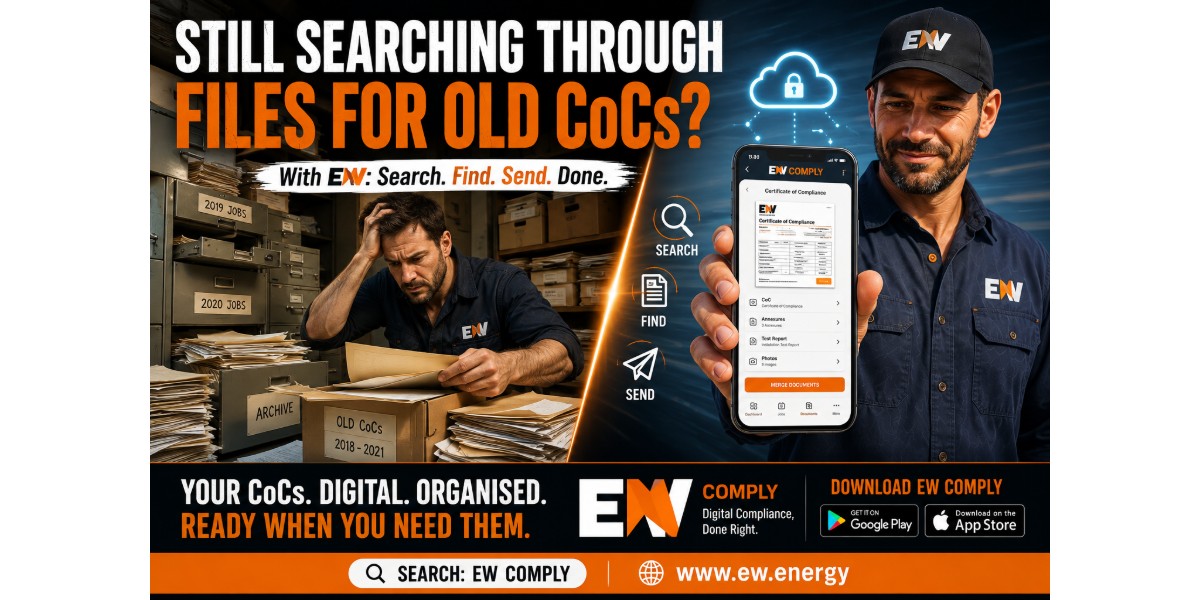
This is one of the problems Energy Warehouse (EW) is designed to address.
By moving electrical compliance records from traditional paper filing systems into an organised digital environment, contractors can build a searchable history of their completed work.
Instead of asking:
"Where did we put that CoC?"
you can search your digital records and retrieve the information you need.
The move toward electronic CoCs is already visible in the South African electrical industry. ECA(SA), for example, describes electronic CoC technology as a way to create, issue and securely store CoCs online, with documentation readily accessible when required. (ecasa.co.za)
The Problem Isn't Only Completing the CoC
Most conversations about digital compliance focus on how quickly a CoC can be completed.
That's important.
But there is another part of the compliance lifecycle that receives far less attention:
What happens to the CoC afterwards?
A Certificate of Compliance isn't necessarily a document you issue once and never need again.
Customers may request copies.
Properties change hands.
Businesses may require historical records.
Contractors themselves may need to review previous work.
And electrical compliance documentation can extend beyond the one-page CoC to include the test report, annexures and other supporting information. The Electrical Conformance Board specifically notes the importance of accompanying test reports and annexures. (Electrical Conformance Board)
The documentation therefore needs to remain organised and accessible.
And that's where paper begins to show its age.
The Traditional Filing Cabinet
For decades, the filing cabinet has effectively been the electrical contractor's database.
Complete the paperwork.
Make a copy.
Put it in a folder.
File it alphabetically, chronologically or according to job number.
If the system is maintained perfectly, it can work.
The problem is that real businesses aren't always perfect.
A document gets filed in the wrong folder.
Someone removes a file and doesn't return it.
A folder gets moved.
A filing cabinet becomes full.
Documents get transferred into boxes.
Boxes move into storage.
Years pass.
Then a customer phones:
"You did our electrical CoC three years ago. Could you send me another copy?"
Now somebody starts searching.
Searching for Paper Costs Money
It's easy to think of paper-based filing as inexpensive.
But there are hidden costs everywhere.
Paper.
Printing.
Ink.
Folders.
Filing cabinets.
Storage space.
Scanning.
And, most importantly:
Time.
If an employee spends 20 minutes searching for an old document, that's 20 minutes that could have been spent on something productive.
Do that repeatedly throughout the year and those minutes become hours.
Digital record keeping changes the equation.
Search Instead of Search Through
There's an important difference between these two phrases:
Search through your files.
and
Search your files.
With a paper system, you're physically searching through documents.
With an organised digital system, you're searching for information.
With EW, completed compliance documentation can form part of your digital records, helping you retrieve previous work using relevant job information.
That changes the entire experience of managing historical CoCs.
Imagine This Scenario
A customer phones your office:
"Hi, you completed our electrical CoC last year. We're selling the property and I need the documentation again."
The old way
Someone needs to determine approximately when the work was completed.
Find the appropriate filing cabinet.
Locate the folder.
Find the CoC.
Find the relevant annexures.
Scan the paperwork.
Save the files.
Prepare the documents.
Email them to the customer.
The EW way
Search for the job.
Find the documentation.
Share it digitally.
Search. Find. Send.
That's the administrative experience we should be working towards.
Your Compliance Records Are a Business Asset
Electrical contractors often think about CoCs as paperwork.
But a completed compliance record is actually part of your company's history.
Over five or ten years, an established contractor may accumulate records relating to hundreds or thousands of properties.
That information has value.
It tells you:
- Who your customers are
- Where you've worked
- When work was completed
- What documentation was issued
- What supporting evidence was captured
Organising that information digitally turns your archive into something much more useful.
It becomes a searchable business resource.
One Job. One Digital Record.
One of the biggest problems with traditional electrical administration is that the information relating to one job can end up scattered everywhere.
The CoC: in a folder.
Test information: on paper.
Photos: on someone's phone.
Annexures: somewhere on the office computer.
Additional documents: attached to an email.
Customer communication: in WhatsApp.
Months later, somebody needs to reconstruct the complete job.
EW provides an opportunity to bring the compliance workflow together digitally.
Keep the CoC and Annexures Together
Annexures are an important part of compliance documentation.
The Electrical Conformance Board highlights several types of annexures that may accompany electrical compliance documentation, depending on the installation and tests involved. (Electrical Conformance Board)
EW allows annexures to form part of the digital workflow.
Instead of completing your CoC in one place and managing your annexures somewhere else, you can keep the documentation associated with the relevant job.
That's a much cleaner administrative process.
Keep Images With the Job
Photographs can provide useful supporting evidence.
But photographs without context aren't nearly as valuable.
Imagine scrolling through thousands of photographs on a company phone trying to identify one particular DB.
Which customer?
Which property?
Which date?
Was this photograph before or after the repair?
The ECB also recommends that electricians take photographs of work performed, including before-and-after evidence. (Electrical Conformance Board)
EW allows relevant images to become part of the job workflow.
Now the photograph has context.
Merge Your Documents Into One PDF
This is an especially powerful part of the EW workflow.
You've completed the CoC.
Your annexures are ready.
Your supporting documents have been uploaded.
Now you still need to give the customer a professional document pack.
Traditionally, that could mean downloading files, arranging them, using separate PDF software, merging them and checking the final document.
With EW, you can streamline that process.
Select your documents.
Arrange them in the correct order.
Click Merge Documents.
Preview the merged PDF.
Share it with your customer.
One job. One PDF. Done.
This can be done through the EW Website or EW Comply App.
Share Through WhatsApp or Email
Once your documentation is ready, it can be shared electronically.
That fits naturally into the way electrical contractors already communicate with customers.
Complete.
Merge.
Preview.
Share.
Archive.
The objective is to remove unnecessary steps from the administrative process.
Cloud Storage Is About More Than Backup
When people hear "cloud storage", they often think only about backup.
But the real business value goes much further.
It's about organisation and accessibility.
A digital record can be searched.
A previous job can be retrieved.
Documentation can be shared.
Information can remain associated with the relevant project.
The archive becomes active instead of passive.
What Happens If Your Laptop Breaks?
This is another weakness of storing documentation on one computer.
Computers fail.
Hard drives fail.
Laptops get stolen.
Devices get replaced.
Employees accidentally delete files.
A contractor who relies on a single office computer creates a significant point of failure for important business records.
Cloud-based record keeping reduces that dependence on a single physical device.
Your company's compliance history shouldn't exist only on the laptop sitting in your office.
What Happens When an Employee Leaves?
This becomes increasingly important as an electrical company grows.
Imagine one electrician has been completing jobs for your company for three years.
Their photographs are on their phone.
Some documents are on their laptop.
Other information is buried in WhatsApp conversations.
Then they leave the company.
Where is the company's information?
A centralised digital workflow helps businesses keep job information within the company's system instead of allowing records to become fragmented across employees and devices.
Team Members Can Work Together
EW also allows businesses to add team members.
That means the compliance process doesn't have to depend entirely on one individual.
For example:
Electrician
Performs the testing and captures information.
Assistant
Captures supporting information or images.
Administrator
Manages documentation.
Supervisor
Reviews job information and progress.
The job becomes part of the company's workflow rather than living with one person.
Built-In Checks and Balances
Storing information is important.
But the quality of the information being stored matters too.
EW incorporates built-in checks and balances and test parameters to support users through the compliance process.
The objective is to help electricians identify information that may have been overlooked and encourage greater consistency when completing documentation.
This approach is consistent with the broader benefits being associated with digital CoC systems in South Africa; ECA(SA), for example, highlights built-in validations as a way of reducing errors. (ecasa.co.za)
Importantly, the electrician remains responsible for the inspection, testing and professional compliance decisions.
Technology supports the professional.
It doesn't replace the professional.
Better Records. Better Customer Service.
Imagine two contractors.
A customer contacts Contractor A requesting an old CoC.
The answer is:
"We'll have to look for it. We'll get back to you."
The customer contacts Contractor B.
They search for the job, retrieve the documentation and send it digitally.
Which company appears more organised?
Which company looks more professional?
Administrative efficiency forms part of the customer's overall experience of your business.
Digital Records Can Help With Repeat Business
Historical records can also become useful when customers return.
If you've previously worked at a property, having an accessible history gives you context.
You know the customer.
You know the property.
You have previous documentation.
You may have photographs.
You may have supporting information.
Your compliance archive becomes more than somewhere you store documents.
It becomes part of your customer history.
Less Paper. Less Physical Storage.
Filing cabinets take up space.
Eventually they're full.
Then you buy another one.
Then another.
Eventually old records move into boxes.
Those boxes need somewhere to go.
For a small contractor, that can mean an increasingly crowded office.
For a larger contractor, document storage can become a significant administrative exercise.
Digitalisation reduces dependence on physical storage.
Stop Turning Digital Documents Into Paper and Back Again
Think about this traditional process:
A document starts digitally.
It gets printed.
Someone completes it.
It gets scanned.
The scan gets saved back onto a computer.
We've taken a digital document, converted it into paper and then converted it back into a digital document.
That's exactly the kind of unnecessary process digital compliance can remove.
The Value Becomes Greater Over Time
The real value of digital record keeping may not be obvious after your first CoC.
It becomes obvious after your 1,000th CoC.
Imagine opening EW several years from now and having an organised digital history of your company's compliance work.
Customers.
Properties.
CoCs.
Annexures.
Images.
Supporting documents.
Instead of rooms full of paperwork, you've built a searchable digital archive.
The earlier you start building that history, the more useful it can become.
Save Time at Both Ends of the CoC
This is perhaps the most important point.
Digital CoCs can save time when you create the documentation.
Digital storage can save time when you need it again.
And EW's document-merging functionality can save time when you deliver the final documentation to your customer.
So the efficiency benefit exists throughout the document lifecycle:
CREATE → CAPTURE → MERGE → SHARE → STORE → SEARCH → RETRIEVE
That's much bigger than simply replacing handwriting with typing.
It's about changing the entire administrative workflow.
The Electrical Industry Is Moving Digital
This isn't only an EW view.
Electronic CoC systems are increasingly being positioned within the South African electrical industry as tools for improving efficiency, accuracy, security and accessibility. ECA(SA) says its electronic CoC system replaces traditional paper processes with a digital solution and highlights online storage, traceability and error-reducing validations among the benefits. (ecasa.co.za)
EW is part of this broader move towards digital electrical compliance.
But our objective isn't simply to make a paper form electronic.
The opportunity is much bigger.
Adding Value to the Electrical Industry
EW's objective is to add value to the electrical industry.
Electricians are highly skilled professionals.
Every hour spent looking through filing cabinets, scanning documents, searching through photographs, manually merging PDFs or reconstructing old jobs is an hour that could potentially be used more productively.
Technology can't replace the electrician.
But it can remove unnecessary administration surrounding the electrician.
That means more time for:
- Customers
- Inspections
- Installations
- Quotations
- Team management
- Business development
- Family
And less time looking for paperwork.
Frequently Asked Questions
Can EW store my completed CoCs digitally?
EW provides a digital workflow for managing completed compliance documentation and associated job information, reducing reliance on physical filing systems.
Can I find an old CoC?
Digital records make historical jobs considerably easier to organise and retrieve than searching through physical filing cabinets.
Can I capture photographs through EW?
Yes. Relevant images and job evidence can form part of the digital workflow.
Can I complete annexures digitally?
Yes. EW supports annexures as part of the compliance process.
Can I merge documents into one PDF?
Yes. Select the documents you want, arrange them in the required order, merge them and preview the resulting PDF.
Can I share the final documentation?
Yes. Completed documentation can be shared electronically, including via WhatsApp or email.
Can my team use EW?
Yes. EW supports team members, helping electrical contractors create a more centralised and collaborative workflow.
Does digital software replace the electrician's compliance responsibility?
No. Under South Africa's Electrical Installation Regulations, the relevant registered person remains responsible for inspection, testing and issuing the Certificate of Compliance in accordance with the regulatory requirements. (SAFLII)
Conclusion
Your filing cabinet should not determine how quickly you can serve a customer.
And your company's compliance history shouldn't depend on somebody remembering where a document from three years ago was filed.
Electrical compliance records are important business documents.
They deserve a modern approach.
With Energy Warehouse, contractors can move towards a workflow where CoCs, annexures, images and supporting documentation are organised around the relevant job.
Complete the CoC.
Capture the information.
Merge the documents.
Share the PDF.
Store the record.
And when you need it again:
Search instead of searching through.
That's the difference digital compliance can make.
Stop Looking for CoCs. Start Searching for Them.
Move your electrical compliance administration towards a smarter digital workflow with EW Comply.
Download EW Comply from Google Play or the Apple App Store.
Search: EW Comply
Book a demo today and see how EW can make your admin life easier.
Energy Warehouse — Digital Compliance, Done Right.