
Why Templates Save Electrical Contractors Hours Every Month
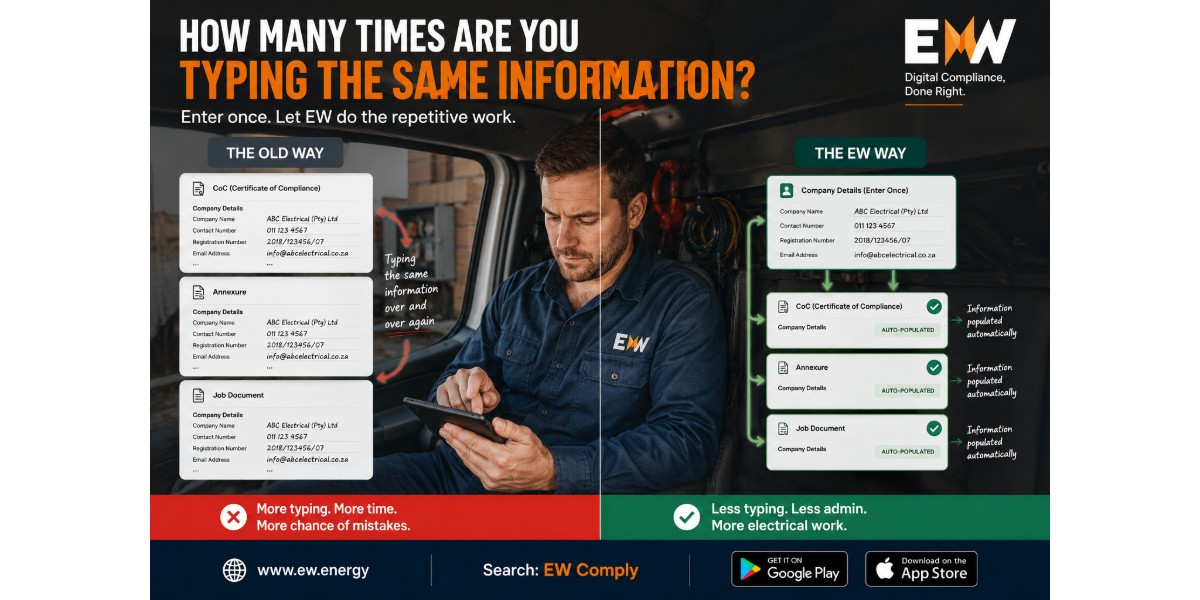
How many times a month do you type the same information into electrical documents?
Your company details.
Contact information.
Registration information.
Electrician details.
Customer information.
Installation information.
And other information that may already exist somewhere else in your system.
Entering these details once doesn't seem like much work.
But entering the same information across dozens—or even hundreds—of electrical jobs every month adds up.
This is where electrical document templates and intelligent pre-population can make a significant difference.
The principle is simple:
If EW already has the information, why should you type it again?
Repetitive Admin Doesn't Feel Expensive
One of the problems with repetitive administration is that each individual task feels insignificant.
Two minutes here.
Three minutes there.
Copy this information.
Enter that address again.
Find an old document.
Check how something was previously entered.
None of these tasks feels particularly expensive.
But electrical contractors don't complete one job a year.
They repeat these processes again and again.
That's when small inefficiencies become expensive.
Three Minutes Can Become Hours
Consider a simple example.
Imagine repetitive data entry adds just three unnecessary minutes to every job.
If your company completes:
20 jobs per month:
That's approximately 1 hour of repetitive administration.
50 jobs per month:
That's approximately 2.5 hours.
100 jobs per month:
That's approximately 5 hours.
And that's only one repetitive process.
Add document preparation, information searching, PDF merging, filing and sending documents, and administrative time, which can increase substantially.
The bigger question is:
How much of that work actually needs to be done manually?
Enter Once. Use Again.
A modern electrical compliance platform should be able to reuse information where appropriate.
If your company information already exists in your profile, there should be no reason to repeatedly type it into every applicable document.
The same principle can apply to other information already available within the job or customer record.
This is where templates become valuable.
Instead of starting every document from scratch, the system provides a structured starting point.
You then concentrate on the information that is actually specific to the job.
Templates Aren't About Cutting Corners
This distinction is extremely important.
Using templates doesn't mean copying test results from one installation to another.
It doesn't mean assuming that because something complied with the previous job, it complies with the next one.
And it certainly doesn't replace inspection, testing, or professional judgment.
A measurement must still be measured.
An installation must still be inspected.
Test results must relate to the actual installation being tested.
The relevant registered person remains responsible for the compliance process.
Templates should automate repetitive administration, not professional electrical work.
That's a very important difference.
Let the Electrician Concentrate on Electrical Work
Consider the value of an experienced electrician.
Their value comes from their knowledge of electrical installations.
Their ability to inspect.
Their ability to test.
Their ability to identify problems.
Their ability to interpret results.
Their ability to perform electrical work safely.
Their ability to determine whether an installation complies.
It doesn't come from typing the company telephone number for the 50th time.
Technology should therefore remove as much unnecessary administration as reasonably possible.
Less typing. More electrical work.
Templates Can Improve Consistency
Time isn't the only benefit.
Templates can also help create more consistent documentation.
Imagine a company employing several electricians.
Without a structured system, each person may capture information slightly differently.
One person abbreviates the company name.
Another doesn't.
One uses a particular format.
Another uses something different.
Someone mistypes a registration number.
Someone leaves out information they normally include.
Over time, the company's documents can become inconsistent.
A structured digital workflow can help standardize information that needs to remain consistent.
That can produce cleaner, more professional documentation across the business.
Consistency Becomes More Important as Your Business Grows
A sole trader can often keep a significant amount of information in their head.
They know every customer.
They know every job.
They know where the documents are.
But that becomes increasingly difficult when the business grows.
Now you have:
Five electricians.
Three vehicles.
An administrator.
Several jobs are happening simultaneously.
Different people are capturing information.
At that point, the business needs systems.
The process should not depend on everyone remembering how the owner normally completes a document.
Templates help move knowledge from:
"This is how John normally does it."
to:
"This is how our company does it."
That's an important step in building a scalable electrical business.
Templates Reduce Copy-and-Paste Administration
Copy-and-paste is often the unofficial template system used by businesses.
Open an old document.
Make a copy.
Delete the old customer's information.
Enter the new customer's information.
Change the date.
Change the address.
Check everything carefully.
The problem is obvious.
If one old detail isn't removed, incorrect information can carry over into the new document.
A purpose-built template system provides a cleaner approach.
Instead of modifying yesterday's document, you start with the appropriate structure and populate it with the information relevant to today's job.
Customer Information Should Flow Through the Job
Here's another opportunity created by digital systems.
Imagine entering the customer's information when the job is first created.
Why should you then need to manually re-enter that same information into every relevant part of the workflow?
Ideally, information should move through the job.
Customer → Job → Documentation
This is one of the differences between simply completing forms digitally and creating a genuinely connected digital workflow.
Your Company's Information Should Work the Same Way
The same applies to your own business information.
Your company doesn't change its name every time you complete a CoC.
Your contact information doesn't change from one installation to the next.
Where information remains applicable, the system should be able to make use of information it already has.
Again:
Why type something twice if you don't have to?
Templates Can Help Reduce Typing Errors
Everyone makes typing mistakes.
A digit gets reversed.
A word gets misspelled.
A field is entered differently.
The more often information must be entered manually, the more opportunities there are for errors.
Reducing unnecessary repetitive entry can therefore do more than save time.
It can also help reduce avoidable inconsistencies.
Don't Automate Everything
There is another side to this discussion.
Automation isn't automatically good.
Some information should require attention.
A compliance platform shouldn't become so automated that users click through screens without thinking about what they're doing.
This is especially important when dealing with electrical compliance.
That's why the ideal system combines two concepts:
Automation is used where information is repetitive.
and
Checks and balances where information requires attention.
Those two concepts work together.
The objective isn't to make the electrician think less.
It's to stop the electrician from wasting time on things that don't require thinking.
This Is Where EW's Checks and Balances Matter
EW isn't intended to speed up electrical documentation.
The platform also incorporates checks and balances within the workflow.
That distinction is important.
Saving time shouldn't mean sacrificing structure.
Where appropriate, EW can help guide users through the process and highlight information that requires attention.
So the goal becomes:
Automate repetitive information.
Draw attention to important information.
Let the electrician make the professional decision.
That's a much more valuable use of technology.
Think About the Entire Job
Templates also make more sense when they're considered as part of the wider EW workflow.
A job isn't simply one form.
You may have:
CoC
Test information
Annexures
Images
Supporting documents
Comments
Signatures
Final PDF
If information can flow appropriately between these different parts of the job, the electrician experiences less duplication.
And less duplication means less administration.
Small Time Savings Compound
This is one of the most important concepts for electrical business owners to understand.
You don't need one feature that saves an hour.
Ten features that each save a few minutes can potentially have an even greater impact.
Imagine saving:
2 minutes when creating the job.
3 minutes through pre-populated information.
5 minutes to complete documentation digitally.
5 minutes managing annexures.
5 minutes avoiding separate image administration.
5 minutes to merge the final documents.
5 minutes to find the job again later.
Individually, none of those savings sound revolutionary.
Together, they can materially change the administrative workload around a job.
And then you multiply that across hundreds of jobs.
Measure Software in Minutes Saved
Electrical contractors often evaluate software based on its monthly cost.
That's understandable.
But there is another number worth considering:
How much time does it save?
Suppose a system saves your business several hours every month.
What is an hour of your time worth?
What is an hour of your electrician's time worth?
What is an hour of your administrator's time worth?
And, more importantly:
What could your business do with those hours instead?
Complete another job?
Prepare another quotation?
Follow up with customers?
Train employees?
Spend more time growing the company?
That's where administrative efficiency starts becoming commercially valuable.
The Goal Isn't to Work Faster All Day
When we talk about productivity, people sometimes imagine squeezing more work into every available minute.
That's not the objective.
The objective is to eliminate unnecessary work.
If something takes ten minutes and technology can help you complete the same administrative process properly in three, you haven't simply become "faster."
You've recovered seven minutes.
That time now belongs to you again.
Templates Are Really About Giving Time Back
And that's why templates matter.
Not because pre-populated fields are exciting.
They're not.
What is exciting is what happens when hundreds of unnecessary administrative steps disappear from your business.
You spend less time typing.
Less time correcting repetitive information.
Less time copying old documents.
Less time performing administration that software could have handled.
And more time doing the work your customers actually pay you to do.
EW: Less Admin. More Electrical Work.
EW's broader objective isn't simply to turn paper forms into electronic forms.
It's to improve the workflow around electrical compliance.
Templates and reusable information are one part of that.
So are:
Digital CoCs.
Annexures.
Images.
Comments.
Team collaboration.
Offline functionality.
Signature links.
Document merging.
Cloud storage.
Search.
Checks and balances.
Each feature, individually, solves a particular problem.
Together, they can create a much more efficient way of managing electrical compliance administration.
Conclusion
The biggest administrative savings often don't come from dramatic changes.
They come from removing small repetitive tasks.
If your company has already entered the information, don't enter it again unnecessarily.
If information can appropriately flow through the job, let it flow.
If a template can provide the correct starting point, use it.
And reserve the electrician's attention for the things that actually require electrical expertise.
Because the objective of digitalisation isn't to give electricians more technology to manage.
It's to give them less administration to manage.
Enter once. Work smarter.
How Many Times Are You Typing the Same Information?
See how EW Comply can help streamline your electrical compliance workflow and reduce repetitive administration.
Less admin. More electrical work.
Search: EW Comply
Available on Google Play and the App Store
EW — Digital Compliance, Done Right.