

An app system represents the complete infrastructure, architecture, and interconnected components that power modern digital applications. For businesses operating in specialised sectors such as electrical compliance, understanding how an app system functions determines whether your digital tools streamline operations or create bottlenecks. From the underlying system software to user-facing interfaces, every layer plays a critical role in delivering reliable, efficient services.
Understanding Core App System Architecture
An app system comprises multiple architectural layers working in harmony. The presentation layer handles user interactions, whilst the business logic layer processes rules and workflows specific to your industry requirements. Below this sits the data access layer, managing how information moves between application and storage systems.
The Technology Stack Foundation
Modern app systems typically deploy across several technology tiers. The client tier runs on user devices (mobile phones, tablets, desktop computers), whilst the application tier executes business logic on servers, and the data tier manages persistent storage. Each tier must communicate seamlessly to deliver responsive user experiences.
Key components include:
- Front-end frameworks (React Native, Flutter, Swift for iOS)
- Back-end servers and APIs
- Database management systems
- Authentication and security layers
- Cloud infrastructure services
The choice of technology stack significantly impacts development speed, maintenance costs, and scalability potential. For compliance-focused applications, security and audit trails become paramount architectural considerations.
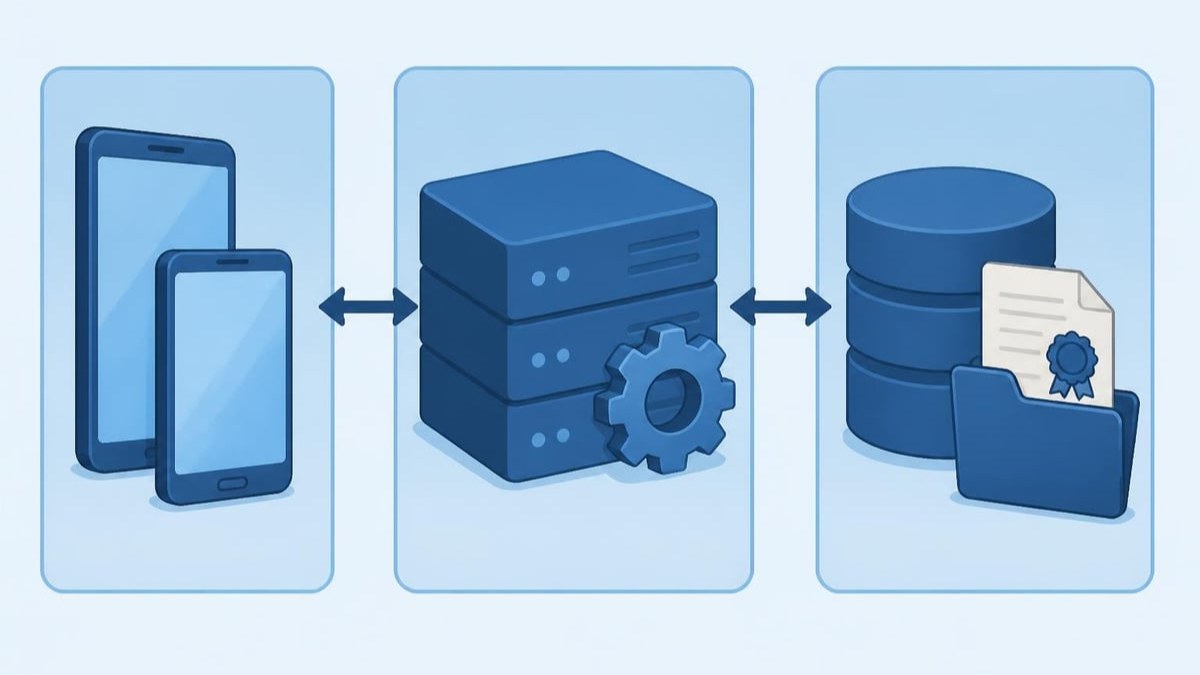
Mobile App System Components
Understanding app components and their lifecycle proves essential for building robust mobile solutions. Activities represent single screens with user interfaces, whilst services handle long-running operations in the background. Broadcast receivers respond to system-wide announcements, and content providers manage shared app data.
The Android manifest file declares each component, defining permissions, hardware requirements, and API levels. This configuration determines how the operating system interacts with your application and what resources it can access.
Native Versus Hybrid Approaches
Organisations face critical decisions when architecting their app system:
| Approach | Advantages | Considerations |
|---|---|---|
| Native | Maximum performance, full platform features, superior UX | Higher development costs, separate iOS/Android codebases |
| Hybrid | Faster development, shared codebase, lower costs | Potential performance limitations, platform-specific challenges |
| Progressive Web | No installation required, universal access | Limited offline capability, reduced native features |
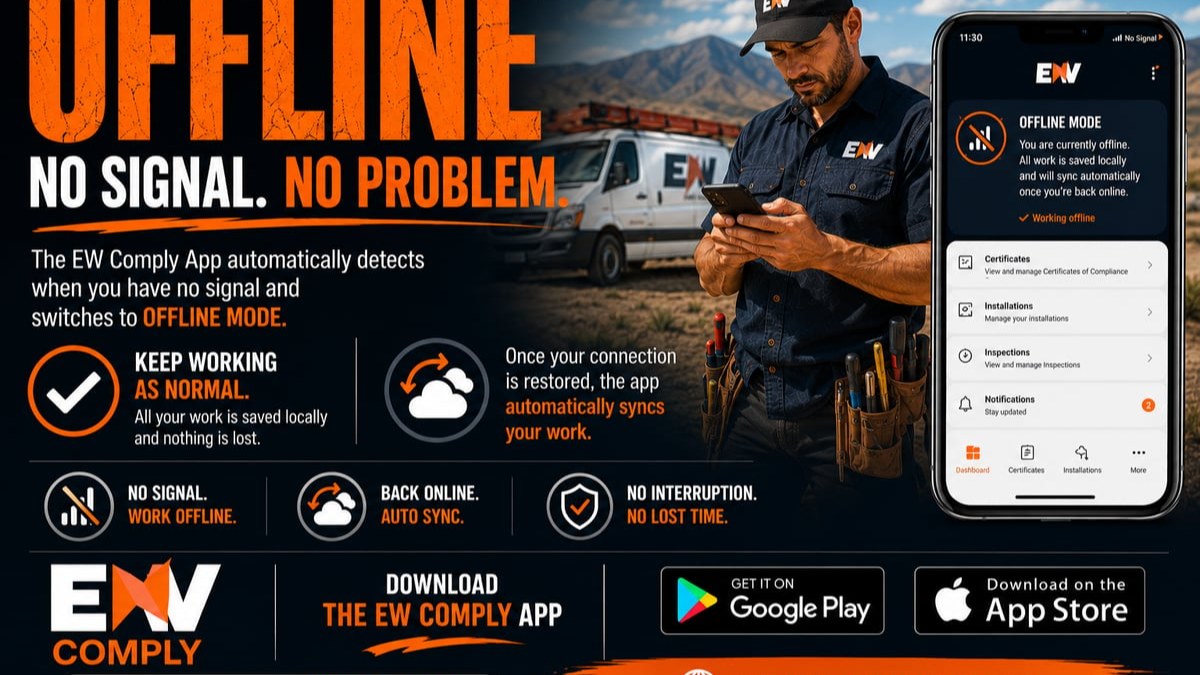
For field-based professionals requiring offline functionality, native or hybrid approaches typically deliver superior results. The platform must continue operating when network connectivity drops, a common scenario on construction sites or remote installations.
Energy Warehouse addresses this challenge through intelligent offline synchronisation. The Offline capability automatically detects signal loss and switches modes, allowing electricians to continue capturing compliance data without interruption. Once connectivity restores, the app system syncs all work to the cloud automatically.
Application Lifecycle Management in Practice
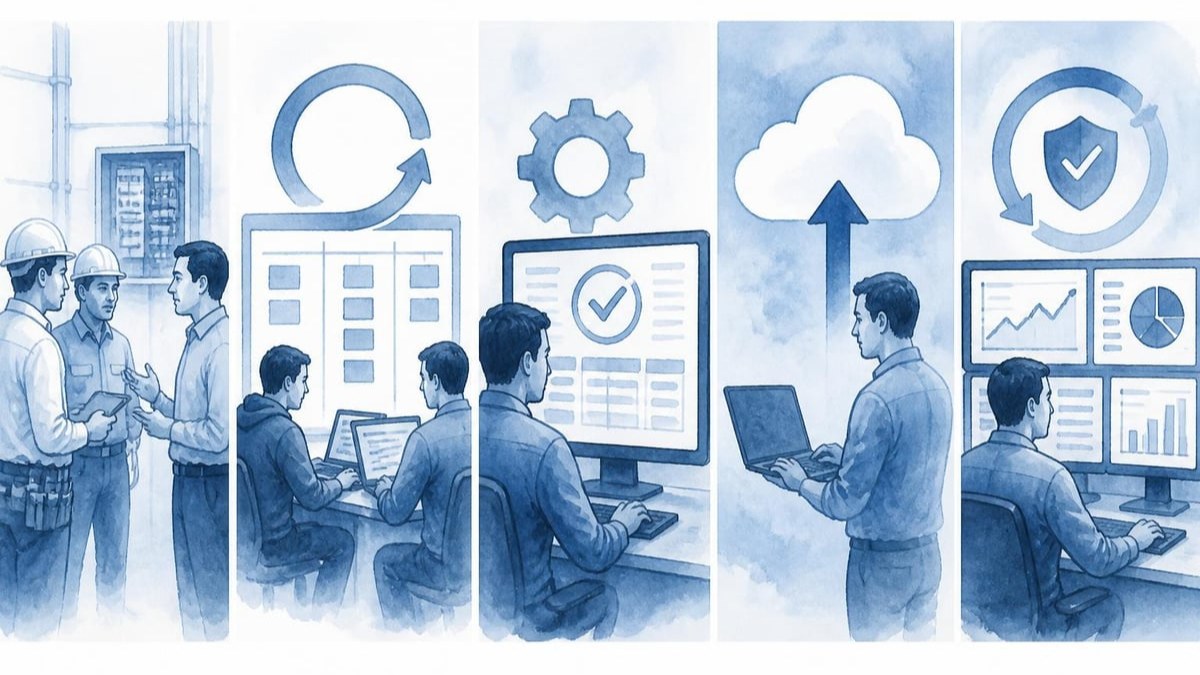
Application Lifecycle Management encompasses every phase from initial concept through eventual retirement. Governance across this lifecycle determines whether your app system evolves to meet changing requirements or becomes technical debt.
Planning and Requirements Phase
Successful app systems begin with thorough requirements analysis. Stakeholder interviews, workflow mapping, and compliance audits reveal what the system must accomplish. For electrical compliance platforms, this means understanding SANS 10142-1 requirements, electrician workflows, client expectations, and regulatory reporting needs.
Requirements translate into user stories and technical specifications. These documents guide development teams and provide measurable criteria for acceptance testing.
Development and Testing Cycles
Agile methodologies dominate modern app system development. Sprint cycles deliver incremental functionality, allowing stakeholders to review progress and adjust priorities. Continuous integration pipelines automatically test code changes, catching defects early when they're cheapest to fix.
Testing layers include:
- Unit tests validating individual components
- Integration tests confirming component interactions
- System tests verifying end-to-end workflows
- User acceptance tests with actual end-users
- Security testing and penetration analysis
Research into mobile application security practices highlights common developer challenges, particularly around authentication, data storage, and network communication. Building security into your app system from inception prevents costly retrofits later.
Deployment and Operations
Modern app systems deploy through continuous delivery pipelines. Code moves from development environments through staging for quality assurance, finally reaching production when all tests pass. Cloud platforms enable blue-green deployments, where new versions run alongside old ones until teams confirm stability.
Monitoring tools track performance metrics, error rates, and user behaviour patterns. When the app system encounters issues, automated alerts notify development teams before users experience significant impact.
Microservices and Distributed Systems
Microservices architecture represents a paradigm shift in app system design. Rather than monolithic applications where all functionality resides in one codebase, microservices decompose systems into independent services, each handling specific business capabilities.
An electrical compliance platform might separate certificate generation, document storage, user authentication, and payment processing into discrete microservices. Each service maintains its own database, communicates through well-defined APIs, and can be deployed independently.
Benefits and Trade-offs
Microservices offer compelling advantages for evolving app systems. Teams can update individual services without touching the entire application. Different services can use different technologies, choosing the best tool for each job. Scaling becomes granular, adding capacity only where bottlenecks occur.
However, this architectural approach introduces complexity. Network communication between services creates potential failure points. Distributed transactions across multiple databases require careful coordination. Monitoring and debugging span multiple codebases and deployment environments.
| Aspect | Monolithic | Microservices |
|---|---|---|
| Initial complexity | Lower | Higher |
| Team coordination | Simpler | Requires strong DevOps |
| Deployment risk | Higher (all-or-nothing) | Lower (isolated services) |
| Scaling flexibility | Limited | Highly granular |
| Technology diversity | Constrained | Flexible per service |
For small teams or early-stage products, monolithic app systems often prove more practical. As user bases grow and feature sets expand, migration toward microservices becomes attractive.
Data Architecture and Synchronisation
Every app system requires robust data architecture. Decisions around databases, caching strategies, and synchronisation protocols directly impact performance, reliability, and user experience.
Database Selection Criteria
Relational databases (PostgreSQL, MySQL) excel at enforcing data integrity through schemas and relationships. NoSQL databases (MongoDB, DynamoDB) offer flexibility for evolving data structures and horizontal scaling. Time-series databases specialise in logging and metrics data.
Compliance applications benefit from relational databases' audit capabilities and transactional guarantees. When an electrician signs a Certificate of Compliance, the app system must ensure that signature, timestamp, and associated test results all commit atomically or not at all.
Synchronisation strategies for mobile app systems:
- Optimistic offline: Users work on local copies; conflicts resolve during sync
- Event sourcing: All changes captured as events for replay and reconciliation
- Operational transformation: Concurrent edits merge intelligently without conflicts
- Last-write-wins: Simplest approach but risks data loss in conflicts
Field workers cannot tolerate applications that lose data during synchronisation. Robust conflict resolution algorithms and comprehensive logging ensure changes never disappear, even when multiple team members edit the same job simultaneously. The team collaboration features within modern platforms demonstrate how proper synchronisation enables seamless multi-user workflows.
Security and Compliance Integration
An app system serving regulated industries must embed security and compliance at every level. Encryption, authentication, authorisation, and audit logging form the security foundation.
Authentication Methods
Modern app systems implement multi-factor authentication (MFA) combining something users know (password), something they have (mobile device), and something they are (biometric). Biometric authentication via fingerprint or facial recognition offers excellent user experience whilst maintaining strong security.
The biometric signatures approach demonstrates how cutting-edge security integrates naturally into compliance workflows. Electricians authenticate their identity conclusively, meeting regulatory requirements whilst eliminating the delays of traditional signature processes.
Security layers to implement:
- Transport encryption (TLS/SSL for all network traffic)
- Data-at-rest encryption (database and file storage)
- Token-based API authentication (OAuth 2.0, JWT)
- Role-based access control (RBAC) for permissions
- Security information and event management (SIEM) for threat detection
Following guiding principles for application development ensures your app system meets modern security standards. These principles emphasise secure coding practices, regular dependency updates, and comprehensive security testing.
Audit Trails and Compliance Documentation
Electrical compliance work demands immutable audit trails. The app system must record who created each certificate, when tests were performed, what results were captured, and any subsequent modifications. Hash functions create digital fingerprints of documents, proving they haven't been altered since signing.
Blockchain-inspired approaches can anchor compliance documents to public ledgers, providing independent verification of document creation times and integrity. Whilst full blockchain implementation may prove excessive, borrowing these cryptographic techniques strengthens audit capabilities.
Integration Ecosystems
No app system operates in isolation. Integration with external services, third-party APIs, and legacy systems determines how well your application fits into existing business processes.
API Design and Management
RESTful APIs have dominated integration for years, with GraphQL gaining traction for complex data requirements. Webhook callbacks enable real-time notifications when events occur. Message queues (RabbitMQ, Apache Kafka) handle asynchronous communication between systems.
Well-designed APIs document endpoints clearly, version interfaces to prevent breaking changes, and implement rate limiting to prevent abuse. API gateways centralise authentication, logging, and request routing across microservices.
For electrical compliance platforms, integrations might include:
- Accounting systems for automated invoicing
- Customer relationship management (CRM) tools
- Building information modelling (BIM) software
- Government compliance portals for certificate submission
- Payment processors for client billing
The ability to share documents across multiple channels, such as through direct WhatsApp sharing, illustrates how thoughtful integrations extend app system utility beyond the core platform.
Performance Optimisation Strategies
App system performance directly impacts user satisfaction and adoption rates. Slow applications frustrate users, particularly field workers under time pressure to complete jobs and move to the next site.
Client-Side Optimisation
Mobile applications must minimise battery consumption, memory usage, and network data transfer. Lazy loading defers fetching resources until needed. Image compression reduces bandwidth whilst maintaining acceptable quality. Caching strategies store frequently accessed data locally, reducing server requests.
Profiling tools identify performance bottlenecks. Perhaps PDF generation consumes excessive CPU cycles, or database queries execute inefficiently. Measurement precedes optimisation, ensuring efforts focus where they deliver maximum impact.
Server-Side Scaling
Cloud infrastructure enables horizontal scaling, adding more servers as demand increases. Load balancers distribute requests across server pools. Content delivery networks (CDNs) cache static assets geographically close to users.
Database optimisation through indexing, query tuning, and connection pooling dramatically improves response times. For read-heavy workloads, read replicas offload queries from primary databases.
| Technique | Impact | Complexity |
|---|---|---|
| Database indexing | High for read performance | Low |
| Caching layers (Redis) | Very high for repeated queries | Medium |
| Horizontal scaling | Unlimited capacity growth | High |
| Code profiling | Identifies specific bottlenecks | Low |
| Asynchronous processing | Improves perceived responsiveness | Medium |
Maintenance and Evolution
App systems require ongoing maintenance even after initial deployment. Bug fixes, security patches, operating system updates, and evolving user requirements demand continuous development investment.
Technical Debt Management
Every shortcut taken during development accumulates as technical debt. Quick fixes rather than proper solutions, outdated dependencies, missing documentation, and inadequate test coverage all create future maintenance burdens.
Successful teams allocate development capacity to debt reduction. Refactoring improves code quality without changing functionality. Dependency updates incorporate security patches and new features. Comprehensive testing prevents regression bugs when making changes.
Feature Development and Prioritisation
User feedback, analytics data, and competitive analysis inform feature roadmaps. Which capabilities will drive adoption? What pain points frustrate current users? Where do competitors excel?
Product managers balance new feature development against maintenance needs and technical improvements. A digital platform for electricians must evolve based on field experience, regulatory changes, and emerging technology opportunities whilst maintaining stability for existing users.
Continuous improvement cycles gather feedback, implement enhancements, and measure impact. Successful app systems never reach a finished state but rather adapt continuously to serve users better.
Cloud Infrastructure and DevOps
Cloud platforms (AWS, Azure, Google Cloud) provide the infrastructure foundation for modern app systems. Virtual machines, container orchestration, serverless functions, and managed databases abstract away hardware management.
Container Orchestration
Docker containers package applications with all dependencies, ensuring consistent behaviour across development, testing, and production environments. Kubernetes orchestrates containers at scale, managing deployment, scaling, and self-healing when components fail.
Infrastructure as code (Terraform, CloudFormation) defines cloud resources in version-controlled configuration files. Teams can recreate entire environments reliably, test infrastructure changes before applying them to production, and audit who modified what and when.
DevOps practices that strengthen app systems:
- Automated testing preventing defects reaching users
- Continuous integration catching integration issues immediately
- Continuous deployment reducing time from development to production
- Infrastructure monitoring alerting teams to performance degradation
- Incident response procedures minimising downtime impact
For compliance-focused applications, disaster recovery and business continuity planning prove essential. Regular backups, geographically distributed deployments, and tested restoration procedures ensure certificate data survives infrastructure failures.
The ability to manage compliance documents in the cloud whilst maintaining offline capability demonstrates how cloud infrastructure and mobile app systems complement each other. Neither alone delivers the complete solution electricians require.
Building an effective app system demands careful attention to architecture, security, performance, and continuous evolution. Whether deploying mobile applications for field workers or web platforms for document management, the principles of sound system design remain constant: modularity, security, reliability, and user-centric features. Energy Warehouse applies these principles to electrical compliance, delivering an app system that streamlines certificate creation, improves accuracy through built-in compliance checks, and saves electricians valuable time on every job. Experience how a properly architected digital platform transforms compliance workflows.