
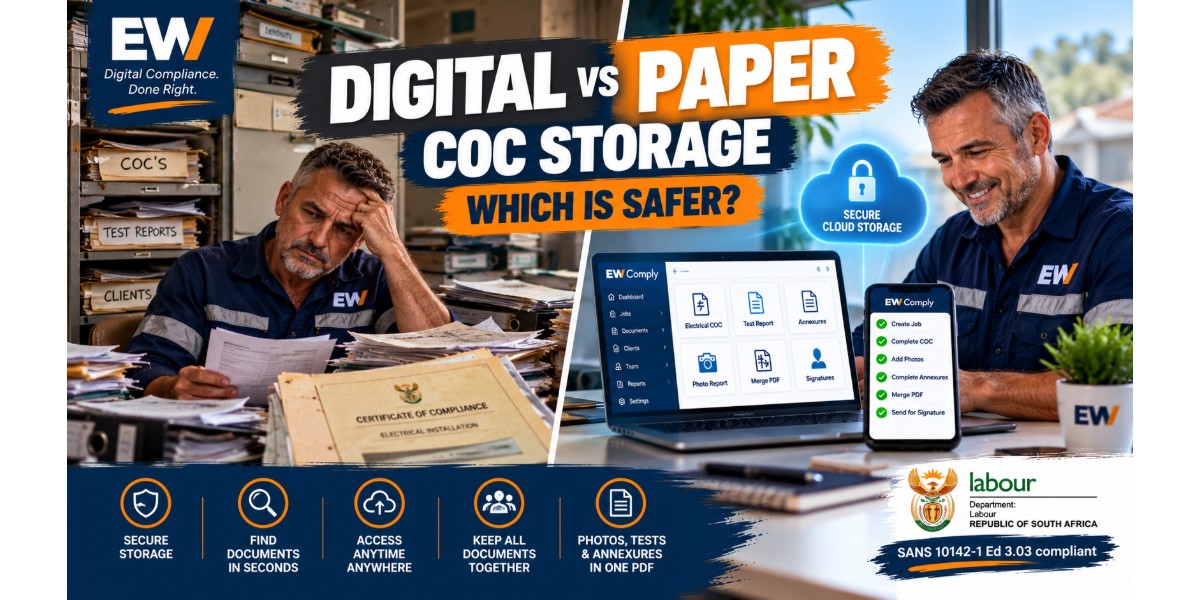
Digital vs Paper COC Storage: Which Is Safer for South African Electricians?
Completing an electrical Certificate of Compliance (COC) is only part of the job.
What happens to that certificate once the work is completed?
Many South African electricians keep copies of completed COCs in filing cabinets, folders, or office archives.
Others save PDFs on their computers, mobile phones or external hard drives.
But what happens when a customer requests a copy of a COC several years later?
What happens if the original document is lost, damaged, or accidentally deleted?
How electricians store their compliance documentation is just as important to their business administration as how they complete it.
Let's compare traditional paper storage with digital and cloud-based COC storage.
1. Traditional Paper COC Storage
For decades, electricians have relied on physical filing systems to store their completed Certificates of Compliance.
A typical filing system might include:
- Copies of electrical COCs
- Test reports
- Additional circuit information
- Inspection notes
- Supporting documents
- Customer details
- Photographs and diagrams
These documents are typically organized by customer name, property address, job number, or date.
This approach can work, particularly for smaller businesses completing relatively few certificates.
However, as the number of completed jobs increases, maintaining a physical archive can become increasingly demanding.
The challenges of paper storage
Physical damage
Water, fire, moisture, and other environmental conditions can damage paper documents.
Misplaced documents
A certificate placed in the wrong folder may become difficult to locate.
Limited accessibility
If the electrician stores documents at the office, they may not be able to access them while working on site.
Storage space
Hundreds or thousands of completed certificates require physical storage space.
Manual retrieval
Finding an old COC may require searching through filing cabinets and archived folders.
Paper storage is familiar, but it has limitations.
2. What Is Digital COC Storage?
Digital COC storage keeps completed compliance documentation in electronic format rather than relying solely on physical copies.
Documents may be stored on:
- A desktop computer
- A laptop
- An external hard drive
- A company server
- A cloud storage service
- A dedicated digital COC platform
However, not all digital storage methods offer the same level of protection.
Saving a PDF to a computer isn't necessarily the same as storing it in a properly managed cloud-based system.
For example, a document saved only on one laptop may become inaccessible if that laptop is stolen or its hard drive fails.
A properly configured cloud storage solution can provide additional protection through backups, controlled access and centralised document management.
3. Paper vs Digital COC Storage: A Comparison
| Feature | Paper Storage | Digital Cloud Storage |
| Physical storage | Filing cabinets and folders | Electronic document storage |
| Finding documents | Manual searching | Searchable records |
| Remote access | Usually limited | Possible with internet access |
| Fire or water damage | Physical documents are vulnerable | Remote copies can remain available |
| Sharing with customers | Scanning or copying may be needed | Electronic sharing |
| Backup options | Photocopies or separate archives | Automated backups may be available |
| Team collaboration | Physical access or manual distribution | Controlled digital access |
| Main risks | Loss, damage and misfiling | Cybersecurity, access and provider risks |
Important: Cloud storage is not automatically safer in every situation. Security depends on how the platform is configured, maintained and backed up.
4. What Happens If a Customer Loses Their COC?
Imagine the following situation.
An electrician completes an electrical inspection and issues a COC.
Two years later, the homeowner contacts the electrician.
"I cannot find my electrical COC. Can you please send me another copy?"
With a paper filing system, the electrician may need to return to the office, identify the correct file, locate the certificate, scan it, and email it to the customer.
With an organised digital system, the process can be considerably simpler.
The electrician can search for the relevant job and retrieve the stored document.
The benefit is not simply storing documents digitally. It is being able to find them when they are needed.
For electrical contractors managing large numbers of properties and customers, this can become a significant administrative advantage.
5. Why Photographs and Supporting Documents Matter
A COC often comes with additional documentation.
Depending on the installation and the nature of the work, this may include:
- Photographs of distribution boards
- Test result photographs
- Additional test reports
- Circuit information
- Electrical diagrams
- Solar installation documentation
- Annexures
- Inspection notes
If these documents are stored in different places, retrieving the complete job record can become difficult.
For example, the COC may be saved on a computer, photographs may remain on a mobile phone, and additional reports may be stored in a separate folder.
A job-based digital system helps keep related documentation together.
This creates a more organised record of the work performed.
It can also help when an electrician needs to refer to previous documentation or explain what was recorded during an inspection.
6. Is Cloud Storage More Secure Than Paper?
Cloud storage can offer important advantages, but the answer depends on the security measures in place.
A well-managed cloud system may provide:
Controlled access
Only authorised users should be able to access the relevant documents.
Backups
Backup systems can reduce the risk of permanent data loss.
Centralised storage
Documents can be organised in one system rather than scattered across multiple devices.
Remote access
Authorised users may retrieve documents without physically returning to the office.
Improved continuity
If an individual device fails, documents stored separately in the cloud may remain accessible.
However, electricians should also consider the risks of digital storage.
These include unauthorised access, weak passwords, service outages, accidental deletion and inadequate backup arrangements.
For that reason, choose a reliable platform.
7. What About POPIA and Customer Information?
Electrical compliance documentation may contain personal information, including customer names, contact details and property addresses.
In South Africa, the Protection of Personal Information Act (POPIA) sets out requirements for lawfully processing and protecting personal information.
Electricians and electrical contractors should therefore consider how they collect, store, access, and share customer information.
This applies to both paper and digital records.
A filing cabinet containing customer information needs appropriate physical protection.
Similarly, a digital platform should implement suitable technical and organisational safeguards.
Digital storage does not remove a business's responsibility to protect customer information.
8. Why Storing Everything Under One Job Makes Sense
Consider an electrician who completes an installation containing multiple distribution boards, additional circuits and solar equipment.
The completed job may contain several documents.
For example:
Electrical COC + Test Report + Annexures + Photographs + Supporting Reports
When these documents are stored separately, information can become fragmented.
A centralised job record makes it easier to manage the complete documentation package.
It also reduces the need to search through multiple folders, applications, or devices.
This is one practical advantage of using dedicated electrical compliance software instead of a collection of unrelated tools.
9. Digital Storage Can Improve Team Collaboration
For electrical contractors with multiple electricians and administrative staff, document management becomes even more important.
One electrician may complete the inspection.
Another team member may help with photos or job details.
An administrator may send completed documentation to the customer.
If everything is stored on one person's computer or mobile phone, collaboration can become difficult.
A shared digital platform with appropriate user permissions can help team members work from the same job record.
This is especially useful for businesses handling multiple jobs at once.
10. How EW Comply Helps Electricians Manage Their Documents
EW Comply brings electrical compliance documentation into one connected digital workflow.
Electricians can use the platform to manage:
- Electrical Certificates of Compliance
- Test reports
- Annexures
- Photographs
- Supporting documentation
- Customer signatures
- Completed PDF documents
- Historical job records
The platform works through a website and mobile app, letting electricians manage documentation on site or in the office.
Instead of keeping information scattered across paper files, individual computers, and mobile phones, EW helps organize it around the relevant job.
This is especially useful when you need to retrieve or share documentation later.
Learn more about digital COC software for South African electricians and how EW Comply can simplify compliance administration.
11. Should Electricians Stop Using Paper Completely?
Not necessarily.
Some electricians may still prefer keeping physical copies of important documentation.
Others may work in environments where digital access is temporarily unavailable.
The objective should not be to eliminate paper at any cost.
Instead, electricians should evaluate which storage method best balances security, accessibility, reliability, and convenience for their business.
A practical approach may involve maintaining secure digital records while retaining physical copies where appropriate.
The most important principle is to keep documents protected, organized, and retrievable.
12. The Future of Electrical Compliance Documentation
Electrical contractors increasingly use digital tools for quotations, invoices, customer communication and project administration.
Compliance documentation is part of that broader transition.
As businesses grow, the ability to locate and share historical documentation becomes increasingly valuable.
A well-organised digital archive can reduce administrative effort and improve the experience for both electricians and their customers.
The question is no longer simply where you store your COCs.
It is how easily and securely you can retrieve them when you need them.
Conclusion: Digital vs Paper COC Storage
Paper storage remains familiar, but it can become increasingly difficult to manage as an electrical business grows.
Digital storage offers advantages in document organisation, retrieval, accessibility and sharing.
Cloud-based storage can also provide additional resilience when appropriate security measures and backups are in place.
For electricians who complete COCs regularly, an organised digital workflow can make a meaningful difference.
Your electrical work deserves professional documentation — and that documentation deserves professional storage.
Take Your COC Administration Digital
Discover how EW Comply helps South African electricians create, manage, store and share compliance documentation.
Explore EW Comply: https://ew.energy/digital-coc-software
Digital Compliance. Done Right.
Frequently Asked Questions
Is digital COC storage safer than paper?
It can be, provided the digital system uses appropriate security measures, backups, and access controls. Paper and digital storage both carry risks that need management.
Can electrical COCs be stored electronically?
You can store electronic records for compliance, subject to applicable legal, record-retention, and authenticity requirements. The storage method does not remove the registered person's responsibilities.
What happens if an electrician loses a paper COC?
The electrician may need to locate another retained copy. An organised digital archive can make retrieving previously stored documentation easier.
Can you store photographs with electrical COCs?
Yes. Suitable digital platforms can link photographs, reports, and supporting documents to the relevant job.
Does cloud storage mean documents can never be lost?
No. Cloud storage can reduce certain risks, but no storage system is completely immune to data loss, outages, or security incidents. Proper backups and recovery procedures remain essential.